Sembcorp Tengeh Floating Solar Farm
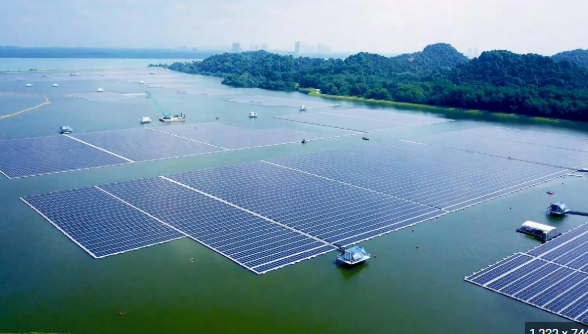
The Sembcorp Tengeh Floating Solar Farm is a landmark renewable energy project in Singapore, officially launched in July 2021. Located on the Tengeh Reservoir, it is Singapore’s First Inland Floating Solar Farm, representing a significant step in the nation's efforts to transition to sustainable energy.
Here is a detailed write-up of the Tengeh Solar Farm:
1. Project Overview and Key Statistics
- Location: Tengeh Reservoir, Western Singapore.
- Capacity: 60 Megawatt-peak (MWp).
- Size: Spans 45 hectares, covering roughly one-third of the reservoir’s surface.
- Infrastructure: Comprises over 122,000 solar panels arranged into 10 floating "islands".
- Key Partners: Developed by Sembcorp Industries and PUB (Singapore's National Water Agency).
2. Purpose and Sustainability Impact
- Meeting Singapore’s solar photovoltaic (PV) capacity goal: The nation aims to deploy at least 2 gigawatt-peak (GWp) by 2030.
- 100% Green Waterworks: The energy generated is sufficient to power all five of PUB’s local water treatment plants, making Singapore one of the few countries in the world with a fully green waterworks system.
- Carbon Reduction: The project reduces carbon emissions by approximately 32 kilotonnes annually, equivalent to taking 7,000 cars off the road.
3. Innovative Design and Technology
Because it is situated on a reservoir, the design addresses unique environmental and technical challenges:
- Double-Glass Panels: Instead of conventional single-glass, the panels are double-glassed to enhance durability in high-humidity, wet environments.
- Cooling Effect: The water beneath the panels provides a natural cooling effect, allowing the system to operate more efficiently than rooftop installations.
- High-Density Polyethylene (HDPE) Floats: The panels are supported by UV-resistant, food-grade certified HDPE floats, ensuring no impact on water quality.
- Advanced Monitoring: The farm uses smart technologies, including AI-driven dashboards and drones for regular inspections, reducing maintenance costs.
4. Environmental and Biodiversity Considerations
A comprehensive environmental impact study was conducted to ensure that wildlife and water quality were not compromised.
- Ventilation Gaps: Sufficient gaps are left between panel clusters to allow sunlight and oxygen to enter the water for aquatic life.
- Additional Aerators: Extra aerators were installed to maintain oxygen levels in the reservoir.
- Wildlife Protection: Studies showed no significant impact on surrounding wildlife, and the local otter population has actually thrived, with numbers doubling in the area.
5. Significance
The Tengeh Floating Solar Farm serves as a blueprint for future renewable energy projects in land-scarce, urban environments. By moving from land to water, Singapore maximizes the utility of its water bodies, overcoming physical constraints to boost its solar energy capacity.

- Alkaff Lake@Bidadari Park
- Sembcorp Tengeh Floating Solar Farm
- Marina Barrage
- Separation Technologies Applied Research and Translation Centre (START)
- Changi Water Reclamation Plant
- Nanyang Environment and Water Research Institute (NEWRI)
- Keppel Marina East Desalination Plant
- Technology Centre for Offshore and Marine, Singapore (TCOMS)
- Coastal Protection and Flood Resilience Institute (CFI) Singapore